Quite a bit of the work we do at MDIN starts with someone who has a device idea, often a clinician or a small company founder, and a very reasonable question: is the idea actually worth pursuing? They don’t need a finished device at that point, and they usually don’t need a big development programme either. What they need is a quick, honest answer on whether the concept holds up before they commit serious time and money to it.
That’s what a concept feasibility study is for. Ours typically run over one to two weeks. In this post I’ll walk through what actually happens during that time and what you get at the end, and I’ll cover when a sprint like this is the right move.
Why we keep it deliberately short
In my experience, the risky period for a new device idea is the stretch where development is happening quietly and nobody has yet asked the awkward questions. Is there already a device that does this? Will the classification make the regulatory route much heavier than expected? Those questions are cheap to answer in week one and expensive to answer in month nine. The whole point of the sprint format is to force them to the front.
A short timebox also keeps the study proportionate. If the answer turns out to be “this needs rethinking”, you’ve spent a couple of weeks finding that out instead of a year. If the answer is positive, you go into development with the big unknowns already mapped.
The first few days: understanding the problem properly
The start of the sprint is mostly questions. What is the device for, who uses it and in what setting, and what does it need to do for the user to consider it a success? We write this up as a first pass at the intended purpose and a rough set of user needs. That document matters more than any other output of the sprint, because the classification and eventually the technical file both hang off it.
We also spend time looking at what already exists. That means competitor and predicate devices, plus a sanity-check level look at prior art. It isn’t a formal patent search (we’d point you at a patent attorney for that), but it’s enough to flag if the core idea is already well covered.
Then there’s the regulatory first pass. Working from the draft intended purpose, we take a view on the likely classification under UK and EU rules and what that implies for the route to market, including whether UKCA or CE marking makes more sense to pursue first. I’ve written about that choice separately in UKCA vs CE marking in 2026. To be clear, this is an informed early view and not a formal determination, and classification can shift as the design firms up. Even so, finding out in week one that your idea is probably Class IIa when you’d assumed Class I changes the shape and cost of the whole programme.
Getting something physical made
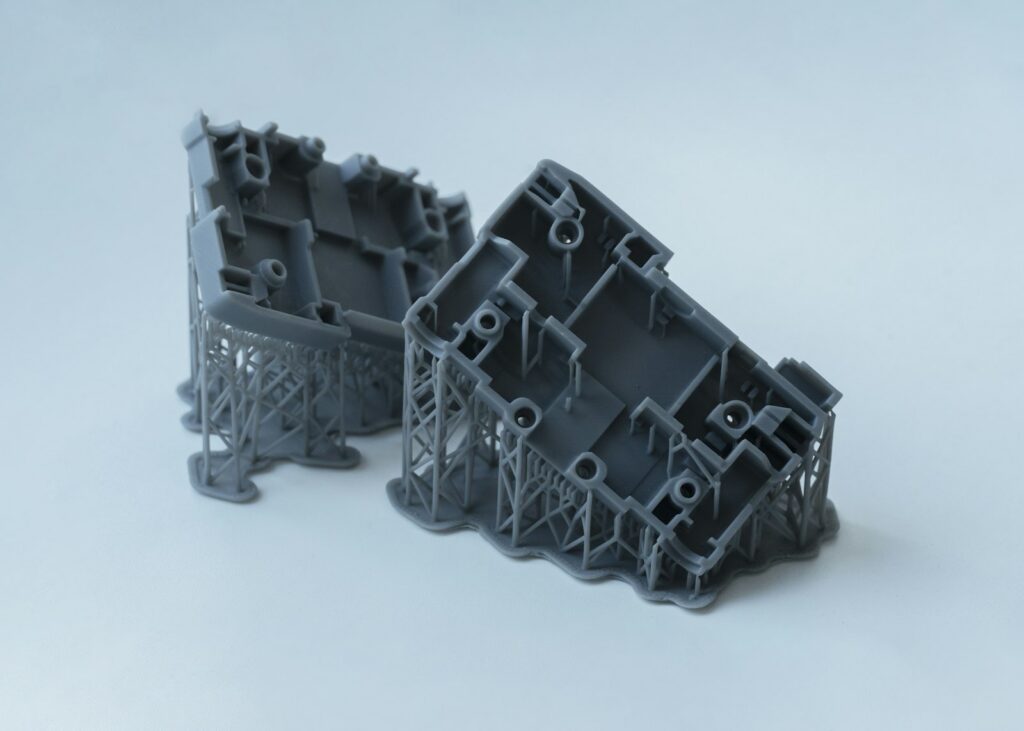
From around the middle of the first week we start sketching and modelling concept options in CAD. Usually that means two or three distinct approaches, because at this stage breadth matters more than finish. Where the concept lives or dies on a physical question, we make parts. We have our own workshop near Bristol with 3D printing and the usual prototyping kit, so turning a CAD concept into something you can hold generally happens in days. For soft-touch or skin-contact concepts we can produce silicone parts from printed moulds.
These are concept-level builds, each made to answer a specific question: does this geometry fit the hand, or does this mechanism actually move the way the CAD says it will? I’ve written elsewhere about the difference between proof-of-concept and prototype builds if you want the longer version. Where a concept hinges on a force or a load, we can put parts on our Mecmesin force tester and get measured figures at the concept stage. That has settled more than one design debate over the years, and it means the feasibility report can say “the seal held at this force” instead of “we think the seal will hold”.
What you get at the end
The sprint closes with a written feasibility report, and I try to keep it practical. It covers the concept options with CAD images and photos of any parts we made, the results from any bench measurements, a risk snapshot of the main technical risks (structured along ISO 14971 lines so it carries forward into the development risk file), the first-pass classification and likely regulatory route, and a blunt recommendation on whether and how to proceed, laid out as a next-step roadmap. You keep the CAD, the test notes and the physical parts. They’re yours.
Sometimes the recommendation is not to proceed, or to change the approach quite substantially. Those are among the most valuable reports we write. It never feels like it in the moment, but a clear “this route has a problem, here’s a better one” after two weeks is worth a great deal compared with discovering the same thing after a funded development programme has burned through its budget.
The report also travels well. If you’re applying for Innovate UK, NIHR i4i or SBRI funding, a feasibility study with real parts and a considered regulatory position makes an application much more convincing. I’ve covered what happens after a grant lands in a separate post.
How this looks in practice: HelloCath
A good example of where this kind of early work leads is HelloCath, who came to us with an early-stage bladder care device: a silicone part with a semi-rigid, spring-like core, which is an awkward combination to make well. We sketched and reviewed different ways the device could work before settling on a direction, then went through several rounds of silicone prototypes in the workshop. Alongside that we mapped out the regulatory pathway, so HelloCath knew which route the device would take to market and what evidence would be needed along the way. Full technical drawings followed so the design could be handed to a manufacturer. They finished with a tested concept and a clear regulatory route, which is what they needed to go after funding. The full write-up is in the HelloCath case study.
When a sprint is the right fit
A feasibility sprint suits you best when the idea is real but unproven. That might be a clinician with a frustration and a sketch, or a founder who needs substance behind a funding application. It’s less useful if your design is already frozen and heading towards verification. At that point the money is better spent on a gap assessment or technical file work, and we can help with those too.
If you’re sitting on an idea and wondering whether it holds up, I’d be happy to have a call and give you an honest view on whether a feasibility sprint would be worth it. The call is free and there’s no obligation. You can book a slot here.
Frequently asked questions
Ours typically run over one to two weeks. The exact length depends on how many concept directions we explore and whether physical parts are needed to answer the key questions, and we agree the scope with you before starting.
Surprisingly little. A description of the idea and the problem it solves is enough. Sketches help if you have them, and input from anyone who’d actually use the device is valuable, but you don’t need CAD or a specification. Producing those is part of the work.
Usually yes, in the form of concept-level parts (3D printed or silicone builds made to answer specific questions), not a device ready for formal testing. Our guide to proof-of-concept vs prototype builds explains the difference.
You get a considered first-pass view on the likely class and regulatory route under UK and EU rules, which is enough to plan and budget around. It isn’t a formal determination. Classification is confirmed as the design and intended purpose firm up.
Yes. We’re happy to sign an NDA before you tell us anything substantive, and many clients do exactly that.