Rapid prototyping for medical devices, built in our workshop near Bristol
We design and build working mechanical prototypes quickly, with the rigs and measurements you need to make decisions. Where a device needs electronics or firmware, we subcontract that work to specialist engineers and manage it within the project.
What you get
A prototype you can hold, fit and test. Not a render.
Bench measurements that answer the risky question first. Force, displacement, fit, repeatability, handling.
SolidWorks CAD and a drawing behind every part. The design is captured, not just made.
A short build report after each round. What we made, what we measured, photos and video, what changes next.
Files that grow with the project. CAD, drawings, a simple bill of materials and test notes, all assigned to you.
We design and build working prototypes of medical devices in our own workshop near Bristol: housings and mechanisms, soft silicone parts, turned and laser-cut components, vacuum-cast short runs and the fixtures to test them. Printed parts are usually ready the same day or overnight, so a design, build and test loop takes days rather than weeks. Rob does the mechanical and materials work himself. Electronics and firmware are not done in-house; when a device needs them we subcontract to specialist engineers, manage that work within the project and say so on the quote.
We keep paperwork light but aligned to the standards you’ll meet later (ISO 13485, ISO 14971, IEC 62366).
If you are not sure which build you actually need yet, we have written up proof of concept versus prototype, and the HelloCath case study shows a set of silicone prototypes taken from an idea to tested parts.
What we prototype
Mechanical
Enclosures, mechanisms and linkages, drive systems, soft-tooling samples and fit/finish parts.
Form & ergonomics.
Handheld form models, grips, control layouts, access for assembly/cleaning; quick formative handling checks.
Materials & build
Material trials (sterilisable/skin-contact), tolerancing tests, fastening/joining approaches, seals and wear points.
Rigs & fixtures
Strain/force/flow rigs, motion fixtures, endurance jigs and simple data capture to measure what matters.
What we make, and on what
- Resin parts on a Formlabs Form 4 and Form 3B: fine features, clear housings, tough, black and heat-resistant resins, soft parts printed directly in Silicone 40A, and BioMed resins for skin-contact prototypes. Most Formlabs materials are on the shelf and any other arrives next day.
- Larger parts and fixtures on a Bambu Lab H2C, printing several materials in one build: PLA, PETG, ABS/ASA, nylon and flexible TPU.
- Turned components on a Warco D250EL lathe: pins, shafts, bushes and threaded parts in aluminium, brass, steel and engineering plastics.
- Laser-cut sheet parts, gaskets and fixture plates.
- Silicone moulds and vacuum-cast parts for short runs in materials closer to production.
- Finishing: heat-set threaded inserts, bonding, light hand machining and sanding.
- Through partners when it saves you time: metal CNC milling, sheet metal, soft tooling for injection-moulded samples, and all electronics and firmware. We say so on the quote.
Turnaround: most printed parts are ready the same day or overnight, with quick reprints between iterations.
Recent projects
- HelloCath: several rounds of silicone prototypes with a semi-rigid spring-like core, tested and refined in the workshop, then full technical drawings ready to hand to a manufacturer.
- A custom-fit wearable support device: from body scan to a functional device the person could wear.
- A foot offloading device taken from concept to manufacture in 14 months, through seven rounds of prototypes and two user trials.
How a prototype round runs
- Agree the question the round must answer and what “good” looks like, in writing.
- CAD and drawings, with material and process chosen for the question, not for convenience.
- Build. Printed parts are ready the same day or overnight.
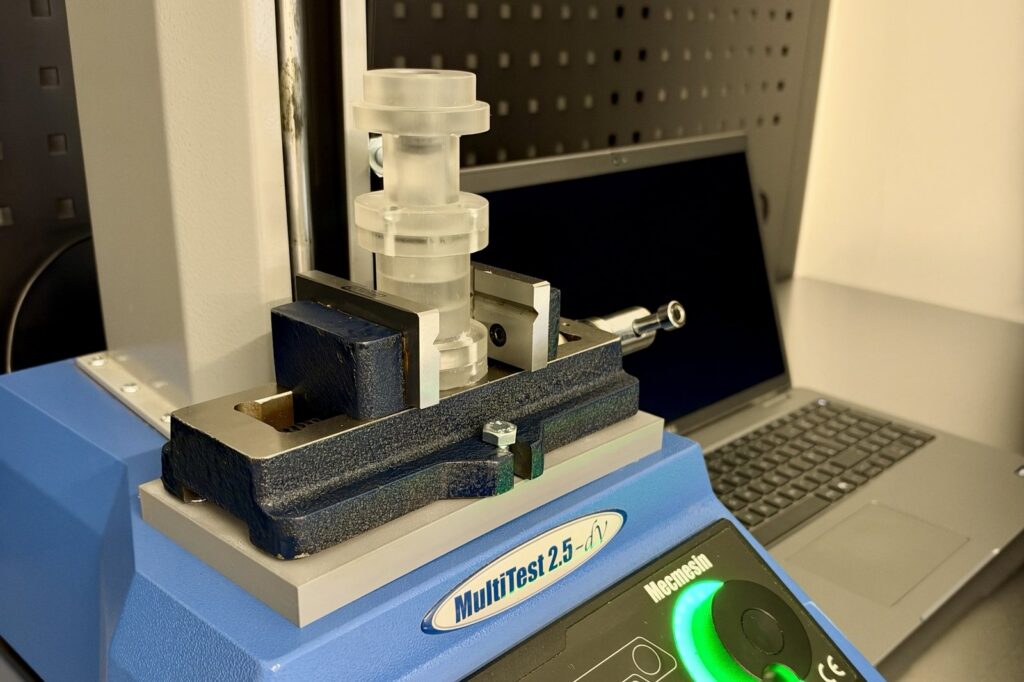
- Test on the bench: fit and function, handling, and forces measured on our Mecmesin tester where the question needs numbers.
- A short report with photos, video and measurements, and a decision on the next round.
Each round is a fixed price, agreed in writing before any work starts. Send us a sketch, a CAD file or a description of the device and we will come back with questions and a proposal for the first round.
FAQs
Yes. Hardware, CAD, drawings, data and notes are assigned to you.
Yes. Many projects start with a call and a sketch.
No. Mechanical and materials work is done here; electronics and firmware are subcontracted to specialist engineers, managed by us within the project and shown as theirs on the quote.
We can build in biocompatible-certified resins and medical silicones so handling trials are realistic. Proving biocompatibility or sterilisation compatibility is a separate verification step, which we can plan with you.
Then we’ve saved you time and budget. We’ll show options and where to pivot.
The prototypes themselves are early-stage, but we keep drawings, decisions and test notes in a form that feeds the design history, so nothing has to be reconstructed later.
As standard, we work under NDA, and everything we produce is client-owned.
Yes. The unit is at Hewish, near junction 21 of the M5, and we will have parts ready to look at.