Proof-of-Concept Builds & Bench Test Rigs
For founders/CTOs who need a clear yes/no backed by real numbers - fast
When a PoC is the right move
- You’re not sure the physics will cooperate (force, flow, dose, repeatability).
- You need evidence for a go/pivot/stop decision or investor meeting.
- A full prototype is overkill – one question must be answered first.
- Off-the-shelf kit won’t replicate your constraints.
Outcome: one question answered with real numbers, not a spreadsheet guess.
The custom-fit wearable case study is a good example of a proof of concept run end to end, and proof of concept versus prototype sets out which build answers which question.
What we build
Proof-of-concept assemblies
The smallest build that demonstrates the mechanism/transfer/actuation
Custom bench rigs
Strain/force/pressure/flow rigs, motion fixtures, endurance jigs, and humidity conditioning in our low-humidity chamber with temperature and humidity logged during runs.
Instrumentation & logging
Load cells, encoders, pressure/flow sensors, simple DAQ; minimal firmware for data capture.
Test methods
Pass/fail criteria, sample plan, how to repeat it next week without us.
The PoC path
Define the question
What must we learn first? Set constraints and success criteria.
Design the minimum
The smallest build that can answer it.
Build the PoC & rig
Simple, swappable parts and a clean bench setup.
Run the tests
Capture the signals that matter; tweak once if needed.
Decide with data
Keep, change or stop - plus the next step.
What we need
- The single question you must answer, plus constraints
- Any prior work, limits, or must-not-fails
- A rough success band (e.g., “≥ X N within Y mm”, “≤ Z% CV”)
Custom test rigs
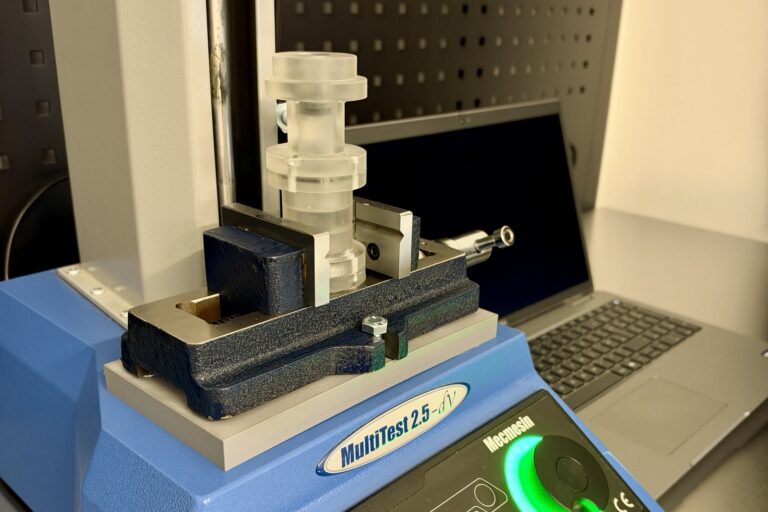
Most rigs start with one question: how do we hold this device the way it’s used, and measure it the same way every time? We design the fixtures, print, laser-cut or machine them in our workshop near Bristol, and run them on our Mecmesin MultiTest 2.5-dV force tester, which measures tension or compression at controlled speed from a couple of newtons up to 2.5 kN, using 200 N and 2.5 kN load cells, with every run logged. When the question is about wear, we build cycling rigs that actuate a mechanism hundreds or thousands of times.
We build rigs inside a wider project, or as a piece of work on their own if you already have a device and no repeatable way to test it. We can make one rig, or a small batch of matching rigs for your own lab or a clinical partner.
Each rig comes with drawings and a written test method, so the test can be repeated and tightened up for design verification later. Our guide to bench testing and test rigs explains how that works.
A proof of concept answers “will this work at all?” with a method you can repeat. When the design is frozen and you need evidence against written requirements for a technical file, that is mechanical verification testing, which we offer as a separate piece of work with an approved protocol and a formal report.
Typical measurements
- Force & torque: breakaway, actuation, hold, repeatability.
- Flow & pressure: steady-state, transients, leakage, back-pressure.
- Position & motion: displacement, velocity profiles, backlash, drift.
- Dose & delivery: accuracy, precision, CV, time-to-dose.
- Endurance: cycles to change/failure, wear points, creep.
We size the rig to the question – clean, repeatable, and easy to re-run.
In-house capability
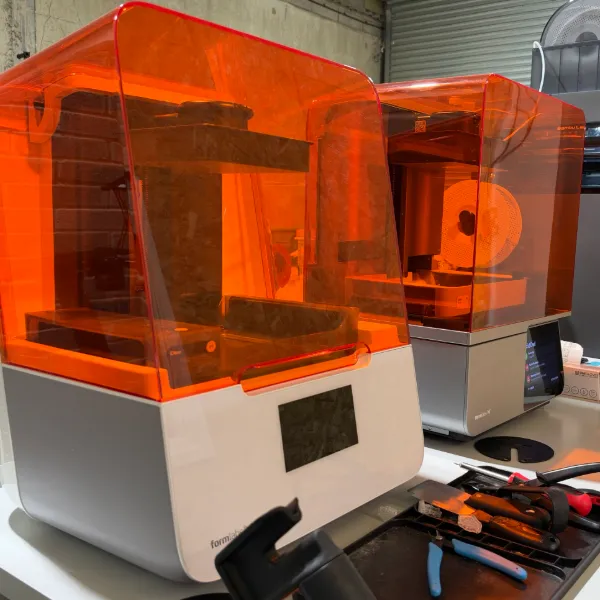
- FDM & SLA printing for same-day parts; light machining/laser.
- Data logging with the Mecmesin software and off-the-shelf loggers.
- Quick reprints and part swaps between runs.
- We outsource only when it truly saves time (e.g., metal CNC).
Deliverables
- PoC assembly and bench rig (or drawings to reproduce).
- Results pack: plots, photos, short video, raw data.
- Test method (v1): setup, calibration notes, pass/fail, repeat steps.
- Decision summary: keep / change / stop, with next-step options.
Proof of concept in practice
- Custom-fit wearable support: the whole business depended on a scan-to-device workflow working for anyone who walked in. We ran it end to end on a real person, produced functional prototypes and mapped the regulatory route for a patient-matched device. The client is now raising on that pack.
- HelloCath: a soft silicone device with a semi-rigid spring core, two things that do not naturally want to work together. Several rounds of silicone prototypes settled the question before drawings were produced.
FAQs
Yes – if we’ve built a dedicated fixture for your question, it’s yours. If it’s a lab rig we reuse, you’ll get drawings/specs to reproduce it.
It’s early-stage. We log what matters and draft a simple method so you can repeat it. Full verification comes after the design stabilises.
Yes – raw data, plots and a short video of the setup and runs.
That’s a good outcome. We’ll propose alternates (geometry/material/drive) or where to stop.
As standard, everything we create for the PoC is client-owned.
Yes. If you already have a device and need a repeatable way to test it, we’ll design and build the rig as a piece of work in its own right.
Yes. We can build a small batch of matching rigs, for example so a clinical partner or a second site can run the same test. Each one is built to the same drawings and checked against the same method.
Our Mecmesin MultiTest 2.5-dV measures tension or compression at controlled speed, from a couple of newtons up to 2.5 kN, using 200 N and 2.5 kN load cells. For wear and endurance questions we build cycling rigs.
No. This is exploratory work to decide whether to proceed. Verification testing comes after design freeze, against written requirements, with an approved protocol and a formal report. We offer it as a separate service: see mechanical verification testing.