Mechanical verification testing, fixtures and documented test evidence
We write the test protocol, build the fixtures, run the force and endurance tests on our Mecmesin frame and write the results up properly for your technical file. We’re an engineering workshop, not an accredited lab. If your test needs one, we’ll tell you.
Who this is for
- Startups and SMEs with a device at or near design freeze and no test equipment of their own.
- Teams who already have a prototype that works but no written evidence that it meets its design inputs.
- Companies whose contract manufacturer will make the parts but will not design the test.
- Grant-funded teams who need verification evidence for a milestone or an investor pack, with the method captured so it can be repeated later.
Proof of concept or verification? A proof of concept answers “will this work at all?” and is allowed to be rough. Verification answers “does the design we are going to make meet the requirements we wrote down?” and has to be traceable: a protocol approved before testing, identified samples, recorded equipment settings, raw data and a report that records what went wrong as well as what passed. If you are still choosing between concepts, start with our proof-of-concept builds and bench test rigs.
What we test
Forces and displacements
Actuation, release and hold forces, button and trigger forces, insertion and withdrawal, pull-off and retention of snap fits and connectors, spring characterisation, compression and tensile strength of joints, bonds and welds.
Stiffness and deflection
Load against deflection of structural parts, housings and supports, at controlled speed with every run logged.
Endurance
Cycling rigs that actuate a mechanism hundreds to tens of thousands of times, with periodic force checks to show how performance drifts.
Functional and dimensional checks
Does the mechanism do what the requirement says, at the stated force, every time, across a sample; dimensions checked against the drawing.
How a test campaign runs
Requirements and acceptance criteria
We turn each design input into a measurable test with a pass/fail limit. Vague or missing requirements are flagged before anything is built.
Protocol
Method, equipment and settings, sample identification, sample size and its rationale, acceptance criteria and data handling, written for your approval before testing starts.
Fixtures
Designed in SolidWorks and printed, laser-cut or turned in the workshop, with drawings, so the test holds the device the way it is used and the same way every time.
Method trial and formal runs
A repeatability check on spare samples first, then the formal runs on identified samples at controlled speed, every run logged, ambient temperature and humidity recorded.
Report and handover
Results against each acceptance criterion, plots, photos and video, deviations and their disposition, equipment list and settings, raw data as CSV. Fixtures, drawings and the method are yours to repeat.
What we need from you
- Your requirements or design inputs, with the limit each test must meet
- Drawings or CAD, and identified samples you can spare for testing
- Any standard or reviewer expectation the test must follow
- The date the evidence is needed by
What we do not test, and where it goes instead
Some verification evidence has to come from an accredited or specialist laboratory, and we’ll tell you when that applies. We do not test biocompatibility (ISO 10993), sterilisation validation or sterile barrier systems (ISO 11135, ISO 11137, ISO 11607), electrical safety or EMC (the IEC 60601 series), software (IEC 62304), packaging and transport simulation (ISTA, ASTM D4169) or formal shelf-life studies. Nor do we run any test where your notified body or the applicable standard expects accredited results.
For those, we help you brief the laboratory, prepare samples and fixtures, and run our own mechanical tests on the conditioned or aged samples when they come back. For most mechanical verification the regulations do not require an accredited laboratory; they require evidence that is traceable, repeatable and reviewed, which is what we produce.
Equipment and records
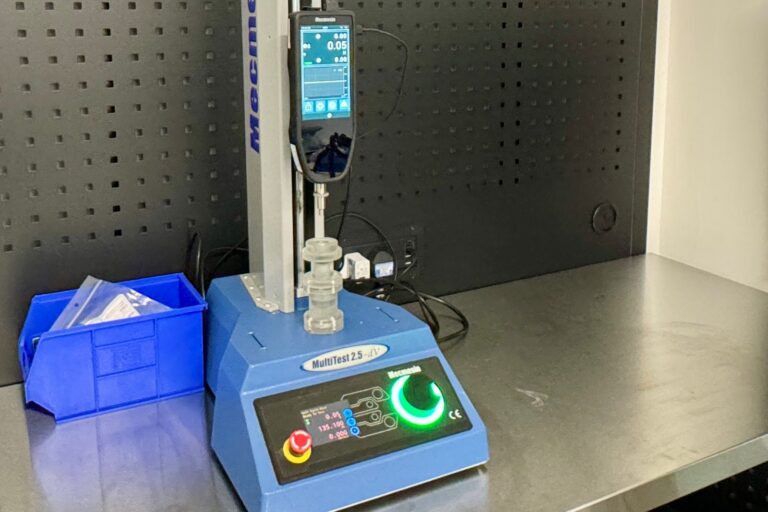
- Mecmesin MultiTest 2.5-dV motorised test frame: tension and compression at controlled speed up to 2.5 kN, with 200 N and 2.5 kN load cells, every run logged.
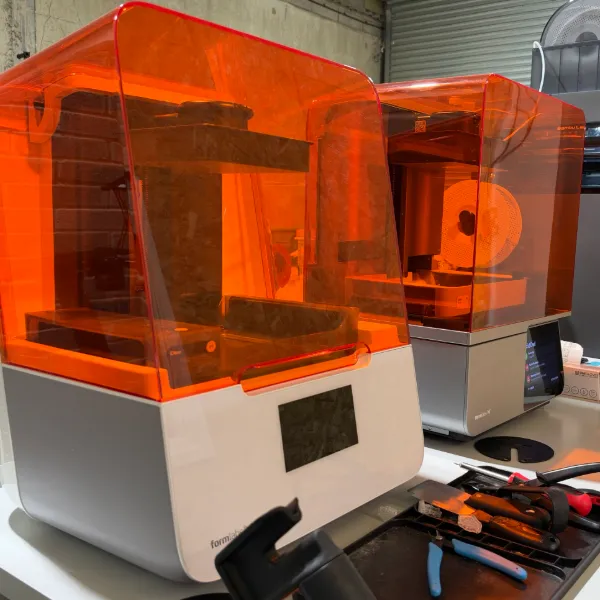
- Custom fixtures printed on Formlabs and Bambu Lab printers, laser-cut, or turned on a Warco D250EL lathe, each with a drawing and a fixture identifier recorded in the report.
- Cycling rigs built from standard actuators and printed parts, sized to the device, with cycle counts logged.
- Conditioning and ambient records: a low-humidity chamber for conditioning samples, and a temperature and humidity logger recording conditions for every run.
- Data as CSV plus plots, photos and short videos of the setup and runs.
Fixture, protocol and a first test series from £3,200 + VAT, quoted as a fixed price after a call and a look at your requirements. Protocol-only and fixture-only work are also available.
Relevant experience
- Custom bench rigs and cycling rigs built as stand-alone pieces of work and as small matching batches for second sites, described on our proof-of-concept and test rig page.
- Our guide to bench testing and test rigs explains how exploratory rigs become verification methods.
Deliverables
- Approved test protocol.
- Fixture drawings and the fixtures themselves.
- Raw data (CSV), plots, photos and short videos of the setup and runs.
- Test report with results against each acceptance criterion, deviations and their disposition, and the equipment list and settings used.
- A requirement-to-test traceability table you can paste into your design verification matrix.
- Optional: a one-page method sheet for your contract manufacturer’s incoming or in-process checks.
FAQs
No. MDIN is an engineering consultancy with a motorised test frame and a workshop. Most mechanical verification does not require accredited testing; it requires traceable, repeatable, reviewed evidence, which is what we produce. Where accreditation is expected, we’ll tell you and help you place the work.
Verification evidence is the manufacturer’s responsibility, and reviewers look for an approved protocol, identified samples, recorded equipment and settings, raw data and a report that records deviations. Our reports are written to that standard. We cannot promise any reviewer’s decision.
Yes. Protocol-only and fixture-only work are both available.
From the risk associated with the requirement and the type of data, with the rationale written into the protocol. We will tell you when a requirement needs a statistician.
Yes. Everything created for your campaign is assigned to you.
Yes, yours or ours, before you send anything.