If you’re developing a medical device in the UK, sooner or later you’ll need facilities you don’t have: a microbiology lab, a biocompatibility lab, a steriliser, a cleanroom, perhaps a CRO for a clinical investigation, and eventually an approved body. This post is a working list of the medical device test labs UK developers actually use, plus the cleanrooms, CROs and approved bodies around them, the names that come up again and again when we’re planning test programmes for clients. We do the bench testing in-house at our workshop near Bristol, and we specify and manage the rest, so we see a fair amount of who does what.
A quick caveat before the list. Inclusion here isn’t a recommendation for your particular device, so treat it as a starting point for your own enquiries, and I’ve put a short section at the end on how to check a lab before you book it.
Bench testing: mechanical, endurance and environmental
This is the part we do ourselves. Force and tensile work runs on a Mecmesin MultiTest 2.5-dV in the workshop with 200 N and 2.5 kN load cells, and around it we design and build custom rigs for whatever the device actually needs measuring: strain, pressure and flow, position and motion, dose and delivery, cycling and endurance (actuating a mechanism hundreds or thousands of times to see what wears, loosens or drifts), and humidity conditioning in our low-humidity chamber with temperature and humidity logged during the run. The instrumentation is load cells, encoders, pressure and flow sensors and simple data acquisition, so a test that doesn’t exist off the shelf (most don’t) gets a fixture, a protocol, a logged run and a report that drops straight into the technical file. There’s more on how we approach this on our proof of concept builds page, which has a section on custom test rigs.
For testing beyond our load range or environmental envelope, or where you want the test run under a UKAS accredited scope, there are independent medical device test labs UK manufacturers use for exactly this. Test Labs is an ISO 17025 accredited laboratory set up specifically for medical devices, and they’re used to working alongside consultancies and small manufacturers. Lucideon in Stoke-on-Trent is strong on materials characterisation, so if your question is about the material itself (degradation, surface analysis, ceramics and polymers) rather than the assembled device, they’re worth a call.
Microbiology, biocompatibility and packaging
Almost every device that touches a patient needs a biological evaluation under ISO 10993, and if it’s supplied sterile you’ll need bioburden, sterility and endotoxin work too. The UK labs we see most often here are Wickham Micro in Hampshire, who cover sterility testing, bioburden and general medical device microbiology, and Medical Engineering Technologies (MET) in Kent, who offer ISO 10993 biocompatibility testing along with packaging validation to ISO 11607, which you’ll need for any sterile barrier system. Eurofins also runs medical device testing and sterilisation validation services across its network, with UK sites, and tends to suit programmes that want one supplier across several test types.
One practical point: the biological evaluation plan should come before the lab quote, not after. Quite a bit of ISO 10993 testing gets bought that a decent evaluation plan would have avoided, and the labs themselves will usually tell you the same if you ask.
Sterilisation
For contract sterilisation the dominant name in the UK is STERIS Applied Sterilization Technologies, which runs gamma irradiation at Bradford and ethylene oxide processing and a testing/validation laboratory at Swindon. For a new device the sterilisation method is a design decision (materials, packaging and dose all interact), so it pays to talk to the steriliser early, and for small clinical investigation batches it’s worth asking directly about minimum runs, as the answer varies by site and by method.
Open-access cleanrooms
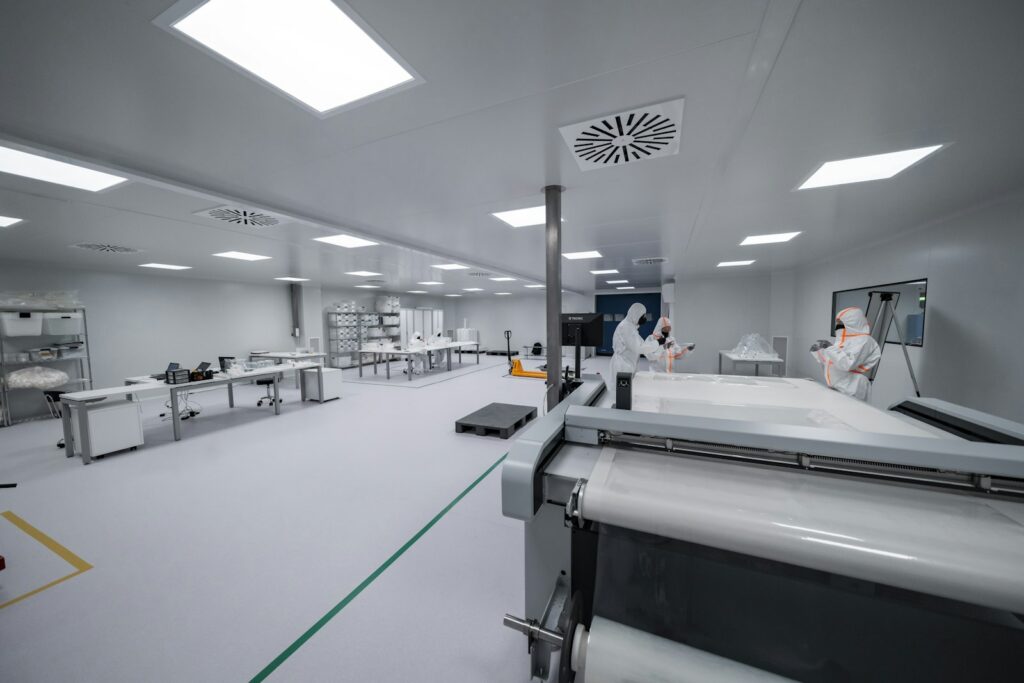
If you need cleanroom assembly for a prototype batch or an early production run, you don’t have to build one. The Medical Technologies Innovation Facility (MTIF) at Nottingham Trent University offers cleanrooms for rental alongside device development and manufacturing support, and it exists precisely for companies at the stage between prototype and production. Europlaz, a medical device contract manufacturer in Essex, rents R&D space with access to its ISO class 7 cleanrooms, which suits teams that want to run their own builds inside someone else’s controlled environment. Beyond the open-access route, many UK contract manufacturers will run pilot builds in their own cleanrooms as a paid project, so if you’re already talking to a moulder it’s worth asking what they can do.
Clinical investigations: CROs and the NIHR
If your device isn’t yet UKCA or CE marked and you want clinical data, you’re into clinical investigation territory, run to ISO 14155 and notified to the MHRA. A CRO takes on the trial management, monitoring and data side, and there are UK CROs that work in devices specifically, Pharmexcel being one we’ve come across. The NIHR HealthTech Research Centres are also worth knowing about: a network of NHS-embedded centres set up to help companies evaluate health technologies, which can be a sensible first conversation if you’re trying to work out what evidence the NHS will actually want. We’ll cover first-in-human studies properly in a future post, as the documentation requirements at that point deserve their own write-up.
Approved bodies
For Class I sterile or measuring devices and anything in Class IIa or above, you’ll eventually need a UK approved body for UKCA marking, or an EU notified body if you’re going the CE route first (CE marked devices remain accepted in Great Britain for now, so plenty of companies do). As of the MHRA list last updated 17 July 2026, there are nine UK approved bodies: BSI Assurance UK, Eurofins E&E CML, Intertek Medical Notified Body UK, Scarlet NB UK, SGS United Kingdom, TUV Rheinland UK, TUV SUD BABT, UL International (UK), and, under the UK-Australia mutual recognition agreement, Australia’s Therapeutic Goods Administration, which is a quirk of the list that surprises people. Their designations differ, so check the scope on GOV.UK before approaching one. BSI, SGS, TUV Rheinland UK, TUV SUD BABT and UL hold IVD designations alongside general medical devices; Eurofins, Intertek, Scarlet and the TGA are designated for general medical devices only; and for active implantables the list is just BSI and TUV SUD BABT. If you’re still deciding between UKCA and CE, we’ve set out how we think about the order in UKCA vs CE marking in 2026.
Medical device test labs UK: how to check one before you book
Before committing to a lab, look it up on the UKAS website, where you can download its schedule of accreditation and check that the specific standard you need is actually on it, rather than a general heading like “mechanical testing”. Testing outside an accredited scope isn’t automatically a problem, particularly for design verification, but you should know which you’re buying. Ask the quote to name the test standard, the sample quantities and what the report will contain, because the report is what goes in the technical file. Ask who signs the report and whether they’ll field questions from an approved body reviewer later, which some labs treat as part of the service and some don’t offer at all. And ask about lead times before you build them into your plan, as the popular labs book out further ahead than people expect.
We sit on the client’s side of all of this: we design and build the device, run the bench testing in our own workshop, write the test protocols and reports, and manage the external labs so the results land in the technical file in a usable state. If you’re putting a test programme together and want a second pair of eyes on it, I’d be happy to have a call. You can book a free 30 minute call here.
FAQ
Not legally, no. Design verification testing can be done in-house or at an unaccredited lab provided the equipment is calibrated and the method is documented, and approved bodies accept that routinely. Accreditation to ISO 17025 gives the result more standing with less scrutiny, so it matters most for the tests closest to your safety claims.
Nine, as of the MHRA list updated 17 July 2026: BSI, Eurofins E&E CML, Intertek, Scarlet NB UK, SGS, TUV Rheinland UK, TUV SUD BABT, UL International (UK) and Australia’s TGA under the mutual recognition agreement. Their scopes differ (five hold IVD designations, two cover active implantables), so check the designation on GOV.UK.
MTIF at Nottingham Trent University rents cleanrooms with device development support, and Europlaz in Essex rents R&D space with access to ISO class 7 cleanrooms. Many contract manufacturers will also run pilot builds in their own cleanrooms as a paid project.
Contract sterilisers such as STERIS AST (gamma at Bradford, ethylene oxide at Swindon) handle UK work, but minimum batch sizes vary by site and method, so ask early. The sterilisation method also affects materials and packaging, which is why we treat it as a design decision rather than a final step.
Most of the bench testing, yes. In our workshop near Bristol we run force and tensile tests on a Mecmesin tester, build custom rigs for pressure, flow, motion, dose delivery, cycling and endurance, and do humidity conditioning in a logged chamber, with the protocols and reports written in-house. For microbiology, biocompatibility, sterilisation and clinical work we specify the testing, place it with the right medical device test labs UK wide and manage the results into the technical file.